
Burleson Previous Residents by Era
One address produces several kinds of evidence. The current parcel card establishes the address, legal description, and county side. Recorder indexes then supply dated transfer leads. Burleson newspaper pages can add local references, and library databases can support a historical household check. Because no verified first online year was located for either county recorder index, an empty web search does not close an older trail. Start with the newest reliable record and work toward the period being studied.
| Source | Verified date reach | Custody | Address trail it can provide |
|---|---|---|---|
| Johnson and Tarrant official-record indexes | First online year not located; status captured through August 2026 | Respective county clerk | Deed, plat, lien, and instrument leads tied to parties or legal descriptions |
| Burleson newspaper collection | 1926–2014 digitized span | Burleson Public Library route to the UNT Portal | Dated notices, street references, businesses, organizations, and local events |
| Federal census | Released under the federal 72-year rule | Library-access genealogy databases | Historical household context, subject to address and county checks |
| City permits and inspections | Exact historical coverage not located | Burleson eTRAKiT, archive, or a focused records request | Work, applicant, owner, and inspection roles at a property |
| Burleson Memorial Cemetery | Current interment search; association dates to 1909 | City and cemetery operator | Burial context that may connect to a dated historical trail |
For a recent transfer, begin with the parcel and recorder. For an older house history, add newspapers, the library catalog, and cemetery context only after the place and time agree. A dated source may be a useful lead, but it should not be stretched into proof that someone lived at the address for every year between two records.
Burleson Previous Residents Need a County
Burleson crosses Johnson and Tarrant Counties. The municipal name on a mailing line therefore does not select the deed office. Use the City GIS address and parcel layers with the County Boundary, City Limit, ZIP, ETJ, and subdivision layers first. If an older instrument, annexation, or boundary remains uncertain, search both county systems and preserve the recording county returned by the record.
Next, consult the current Johnson CAD or Tarrant Appraisal District record, as appropriate. Keep the situs address, owner field, mailing address, account or parcel reference, and legal description distinct. A mailing address is correspondence information, and an owner entry is a property role. Neither one by itself identifies the people who lived there.
Burleson Previous Residents in Deed Indexes
Johnson and Tarrant use publicsearch interfaces with Quick Search and Advanced Search choices, a Search Term field, Recorded Date controls, and index-only or OCR-inclusive searching. A search term can be a grantor, grantee, subdivision, document type, or document number. The captured status dates were August 21, 2026 for Johnson and August 27, 2026 for Tarrant. Those dates indicate a portal snapshot, not a promise of complete historical coverage.
See the Tarrant County official-records search before using a party name or date range as an index lead.
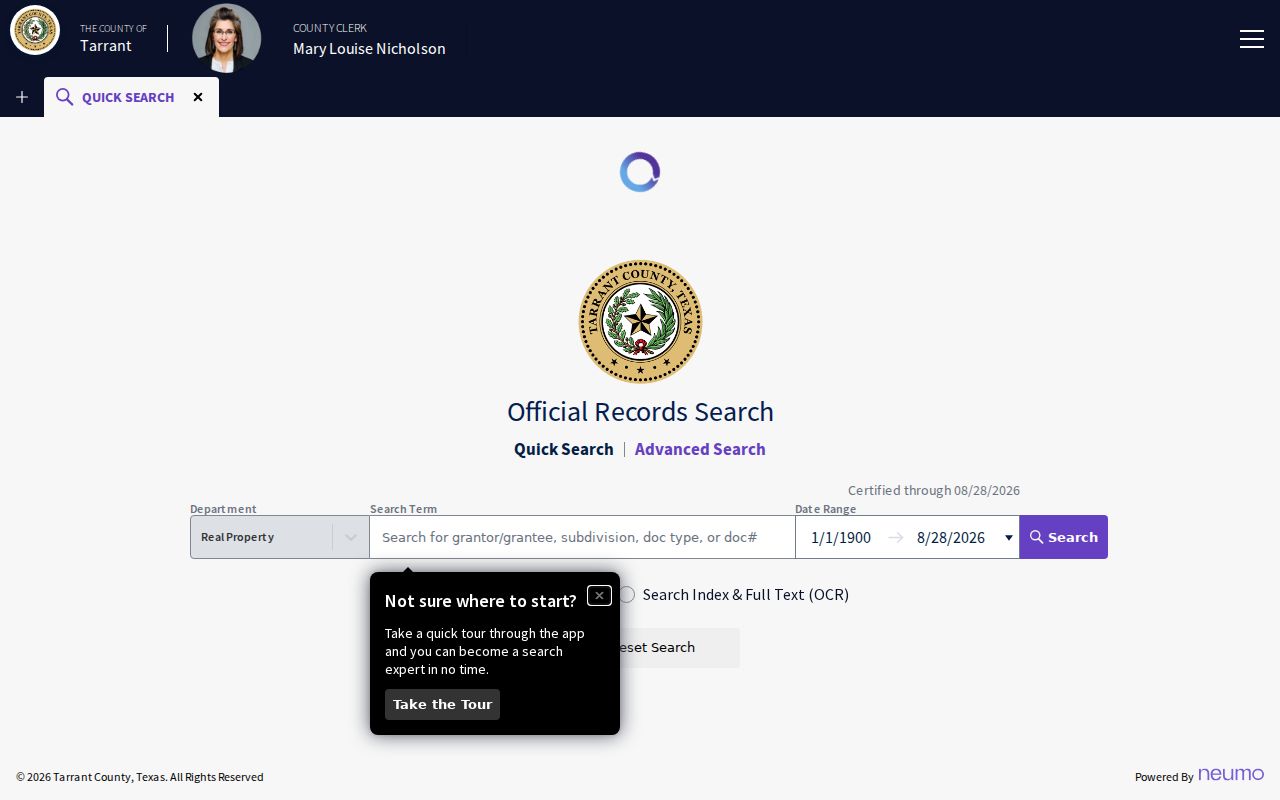
The screen shows why a name alone can be too broad. Pair a party name with document type, date range, subdivision, legal description, or document number when one is available. The online index is not the official repository, so obtain a clerk image or certified copy when proof matters.
Johnson provides public terminals at its Historic Courthouse and Burleson Sub-Courthouse. Tarrant provides online and in-person access through the Central Library and clerk channels. Those access routes do not merge the counties' records. A Tarrant-side instrument remains a Tarrant record even when the address is within Burleson, and the same rule applies on the Johnson side.
Trace Burleson Previous Residents Backward
A deed chain follows instruments, not a presumed sequence of occupants. Start from the current owner and legal description, find the newest acquisition, and then use the seller's earlier purchase to move backward. Preserve the document type, recording date, number or book and page, county, legal description, image status, and a short confidence label at every stop.
- Locate the address in City GIS and confirm the parcel, subdivision, and Johnson or Tarrant side.
- Open the matching CAD or appraisal record and copy the current owner name and legal description exactly as displayed.
- In the county recorder index, find the newest deed where that owner is the grantee, then note the grantor, date, and instrument reference.
- Search that grantor as a grantee on an earlier instrument. The grantor on the newer deed is often the buyer on the prior deed.
- Repeat only while the legal description and county fit. For a gap or a critical claim, inspect the clerk-held image or request a certified copy instead of treating an index result as final proof.
- Grantor and grantee
- The grantor transfers an interest in an instrument; the grantee receives that interest. Their roles are document-specific.
- Chain of title
- A dated sequence of recorded transfers connected by a legal description, not a list of everyone who occupied the property.
- Legal description
- The lot, block, subdivision, survey, or other land description recorded with the property. It can survive street-name changes better than an address.
- Index lead
- A search hit that points to an instrument but still needs image review or clerk confirmation for reliable proof.
Burleson Previous Residents and Permit Dates
Burleson's permit and inspection channels can place work at a property. eTRAKiT offers permit and plan search, map, contractor-search, inspection, and address-location routes; the city also maintains permit activity and code archive categories. These records can identify a work date or an applicant, owner, or contractor role. They do not establish who occupied the address.
The Burleson eTRAKiT portal is the city route for an address-linked permit or inspection lead.

Link a permit to the parcel and its date, then compare it with the nearest deed, newspaper reference, or recorded plat. The city's Environmental Services assumed full OSSF permitting and inspection from Tarrant County Public Health on June 23, 2025, so older septic records may follow a different custody path.
Burleson Past Residents in Newspapers
When a transfer identifies a name, the Burleson News, Burleson Dispatcher, and Burleson Star collection can test whether that name also appears in local context. The digitized resource covers 1926–2014 and supports searches by name, street, business, organization, and spelling variant. OCR is only a lead. Inspect the page image and retain the publication title, date, page, address wording, county context, and what the item actually says.
Pair the household layer cautiously:
- Search the address, surname, and reasonable spelling variants in the dated newspaper collection.
- Record the item year and compare it with the nearest released federal census available through the library's licensed genealogy resources.
- Check the preceding and following years rather than assuming a notice proves continuous presence.
- Use a cemetery or probate reference only as a date and relationship lead, then confirm it with the responsible record custodian where access rules allow.
The Tarrant County Clerk archival-holdings page describes a separate county research channel when an online index or city collection leaves a gap.
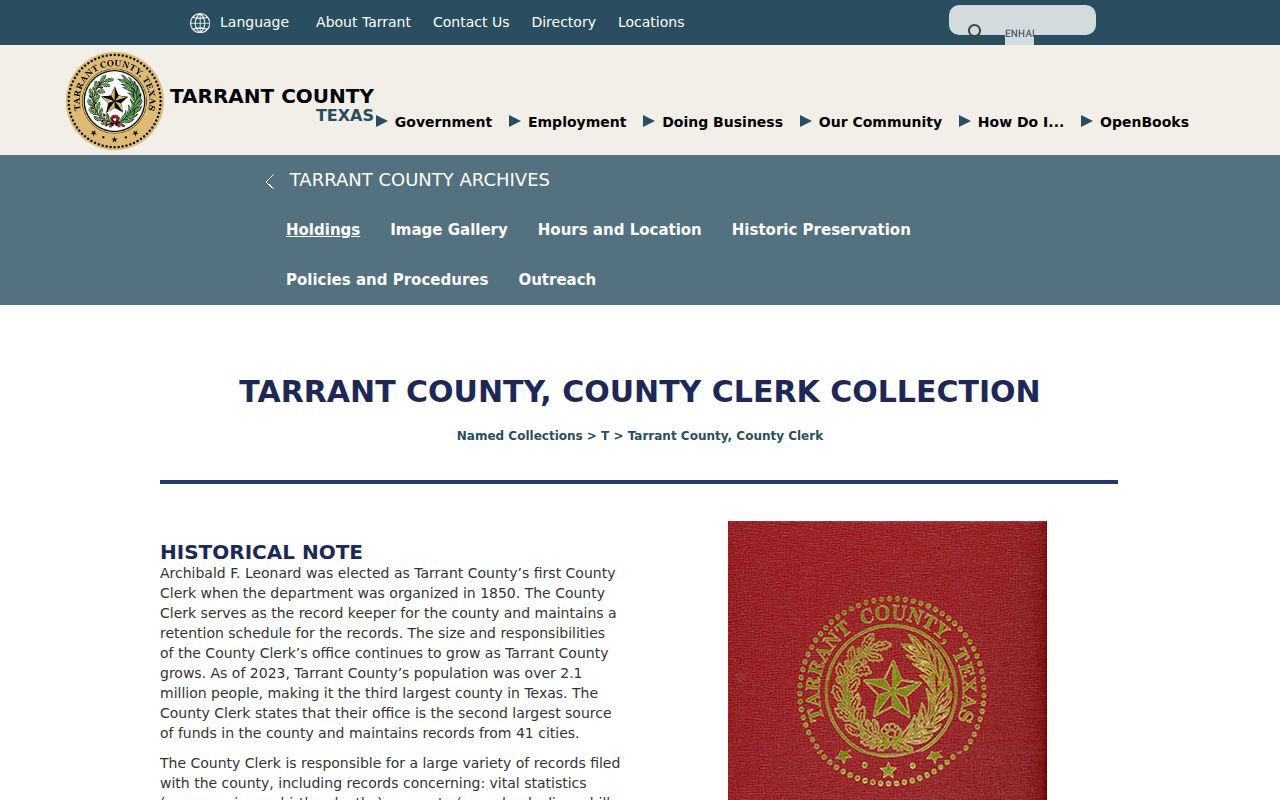
Archive and library help is especially useful when a record predates an online system. Exact local reverse-directory and printed city-directory runs were not located in the official sources, so verify a claimed holding with the library catalog or reference desk before relying on it.
Old Town Burleson Address Clues
Old Town deserves a different kind of address check. Burleson began as a Missouri-Kansas-Texas Railroad depot around 1881 and incorporated in 1912. The Legacy Charrette describes the core as small blocks, narrow lots, and alleys, a form that can make a plat, deed description, newspaper item, and present parcel map more useful together than a street label alone. Northern Texas Traction ran between Fort Worth and Cleburne from 1912 to 1931, adding another dated local layer.
Do not project a current boundary or address pattern backward. Compare the dated city map, annexation layer, plat, and instrument county. The Library of Congress collection did not produce a Burleson city Sanborn map in the official research, so a map for Burleson County or another place named Burleson is not an interchangeable substitute.
For a Johnson County trail that reaches before 1913, record a continuity question rather than assuming a volume survived intact. The 1883 courthouse burned on April 15, 1912, although the Historical Commission reports that most valuable records were saved. Clerk or archive confirmation is the sensible next step when an expected instrument does not appear.
Burleson Previous Residents: Household Limits
House history is strongest when each record is labeled for what it can prove: a verified instrument, an index lead, a newspaper mention, or an unresolved identity. The Burleson Public Library supplies a local route to the catalog, newspapers, Portal to Texas History, Ancestry Library Edition, Fold3, and HeritageQuest. Ancestry Library Edition is available inside the library, so access should not be assumed from home. For the collections themselves, use the Burleson city directory resources rather than treating a newspaper mention as a complete directory entry.
Burial records and related vital material have their own boundaries. Burleson Memorial Cemetery is city-owned and its association dates to 1909, but a burial result is not proof of an address. Texas birth and death records also have protected periods and qualified-applicant rules. Keep the personal question narrow, use the appropriate county or city custodian, and do not turn an old address trail into a current-person profile.
If two sources conflict, retain both citations and their dates. A documented uncertainty is more useful than forcing a name, address, or family connection that the record does not actually support.
Lawful personal use. Research on previous residents is for family history, house history, estate questions, and personal curiosity. Do not use an address trail to track, harass, or harm any living person.